
In the relentless world of heavy industry, the slow grind of metal against earth, rock, and ore is a quiet, constant drain on profitability. While catastrophic failures get immediate attention, abrasive wear is the silent budget killer, consuming parts, fuel, and man-hours with every cycle of your machinery. But there’s a proven, tactical defense: the strategic application of 350LH hard facing electrodes. This isn’t just repair; it’s a transformative maintenance philosophy.
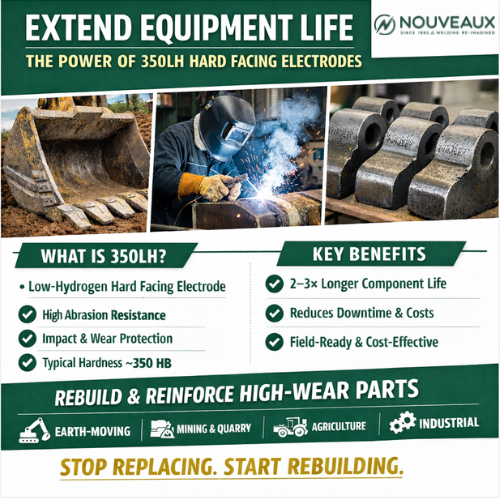
Beyond Repair: The Philosophy of Hard facing
Traditional welding fixes what’s broken. Hard facing prevents it from breaking in the first place. It’s the difference between waiting for a component to fail and proactively armoring it against its specific enemy—whether that’s high-stress abrasion, moderate impact, or a combination of both. The 350LH electrode is engineered to be that armor.
Why “350LH”? Decoding the Specs
The name tells a skilled welder exactly what to expect:
- 350: Refers to the approximate Brinell Hardness (HB) of the weld deposit. This places it in a robust “goldilocks zone”—hard enough to fiercely resist abrasion, yet with sufficient toughness to withstand impact without brittle failure.
- LH (Low Hydrogen): This is the critical operational advantage. Low-hydrogen electrodes are baked to minimize moisture, drastically reducing the risk of hydrogen-induced cracking (HIC) in the weld zone. This is essential for hard facing high-strength steels and thick sections, where stress is high.
The Direct Line to Your ROI: Tangible Benefits
- Slash Parts Expenditure: Instead of buying a new loader blade or crusher hammer every few months, you rebuild and reinforce the original multiple times. The cost of electrodes and labor is a fraction of the cost of new OEM parts.
- Maximize Uptime, Minimize Downtime: Hard facing is a planned maintenance activity. Schedule it during a shift changes or light day, rather than suffering the unplanned downtime of a catastrophic failure in the middle of a critical project.
- Improve Operational Efficiency: A worn, rounded bucket tooth or crusher component requires more power to do the same work. A sharp, hard-faced edge maintains its geometry longer, leading to better penetration, faster cycles, and lower fuel consumption.
- Sustainability Through Durability: The most sustainable part is the one you never have to manufacture, ship, or dispose of. Hard facing is a cornerstone of the circular economy for heavy equipment, keeping material in service for years longer.
Mastering the Application: The Art of the Layer
Success with 350LH hinges on technique. Here’s how to ensure optimal performance:
- Strategic Patterning: Don’t just cover the surface. Apply weld beads in a crosshatch or diamond pattern. This creates a “cobblestone” effect that disrupts the flow of abrasive material, significantly enhancing wear life compared to parallel beads.
- The Buffer Layer Strategy: For highly stressed components or when working on unknown steels, consider a soft buffer layer (using a mild steel electrode) before applying the 350LH. This absorbs stress and prevents delamination.
- Heat Management is Everything: Use interpass temperature control. Allow the part to cool below 200°C (400°F) between layers. This preserves the hardness and prevents the base metal from annealing. Preheating (as per procedure) is non-negotiable for thick sections to prevent cracking.
Spotting the Perfect Use Case: Is 350LH Right For You?
The 350LH excels in a specific battlefield. It’s your go-to for severe abrasion coupled with moderate to heavy impact.
Prime Targets for Reinforcement:
- In the Quarry: Cone crusher mantles, jaw crusher plates, hammer mill hammers, fan blade edges.
- On the Farm: Forage harvester chopper knives, sugar cane knife rolls, subsoiler points.
- At the Mill: Screw conveyors (flight edges), pelletizer dies, mixer agitators.
- On the Road: Asphalt paver screed plates, grader moldboard end bits.
When to Consider a Different Electrode: For pure, extreme-impact applications (like a crusher hammer in a shredder), an austenitic manganese steel electrode might be better. For extreme, low-impact abrasion (like a slurry pump), a higher-chromium alloy could be optimal.
Conclusion: Don’t Just Maintain—Upgrade
Using the 350LH hard facing electrode is a decision to move from reactive to predictive maintenance. It transforms your view of a worn part from “scrap” to an opportunity for an upgrade. You’re not just putting metal back; you’re putting back better, harder, and smarter metal exactly where it’s needed most.
It’s time to see wear not as an inevitable cost, but as a manageable process. Equip your team with the knowledge and the right tools—like the 350LH—and turn your equipment’s weakest points into its most fortified assets.