
If you work in heavy fabrication, pressure vessel manufacturing, or structural steel, you are likely familiar with the Submerged Arc Welding (SAW) process. Known for its high deposition rates and deep penetration, SAW is the backbone of industries requiring long, continuous welds.
But while the welding wire (the electrode) often gets the spotlight, the real hero—or villain, depending on quality—of the weld lies beneath the surface: The Flux.
So, what exactly is SAW flux, and why is it so critical to the success of your weld?
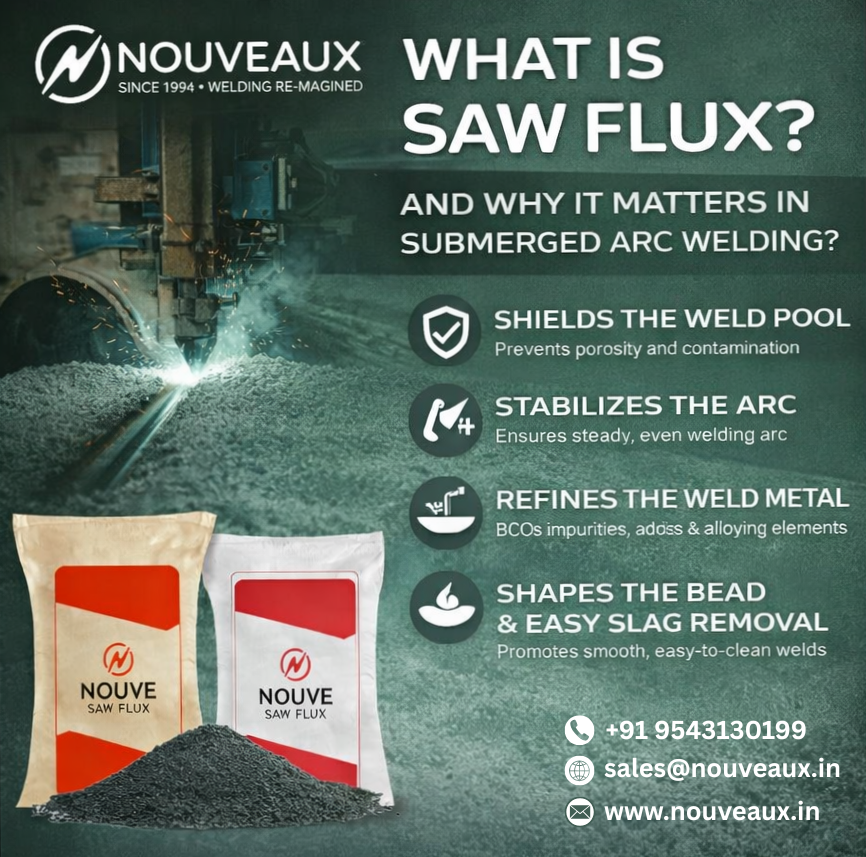
What Is SAW Flux?
In simple terms, SAW flux is a granular, fusible material used in the submerged arc welding process. Before the weld begins, a layer of this granular compound is deposited onto the weld joint. The consumable electrode wire then feeds through this layer into the joint, creating an arc.
Unlike shielding gases used in MIG or TIG welding, the arc in SAW is completely “submerged” beneath the flux layer. This flux serves multiple purposes, acting simultaneously as a shield, a cleanser, and a metallurgical engineer.
The 4 Critical Functions of SAW Flux
Understanding the importance of SAW flux means understanding its four primary roles in the welding process:
1. Shielding the Weld Pool
In welding, exposure to atmospheric gases (Oxygen and Nitrogen) is the enemy. It leads to porosity and brittle welds.
- The Action: As the high heat of the arc melts the wire and the base metal, it also melts a portion of the granular flux. This melting creates a blanket of molten slag and generates shielding gases.
- The Result: This barrier perfectly protects the molten weld pool from contamination, ensuring a clean, dense weld deposit without the need for external gas bottles.
2. Stabilizing the Arc
A stable arc is essential for consistent penetration and a smooth bead appearance.
- The Action: Flux contains ionizing elements (often compounds of potassium or sodium) that help maintain a steady, consistent arc even when voltage fluctuates slightly.
- The Result: This prevents “arc blow” and ensures that the weld metal is deposited evenly.
3. Refining the Weld Metal (Deoxidation)
This is arguably the most important metallurgical function. The base metal being welded often contains impurities like rust, mill scale, or oils. Furthermore, the high heat can cause elements in the steel to oxidize.
- The Action: The flux acts as a chemical cleanser. It contains deoxidizers and scavengers that react with these impurities, drawing them out of the molten puddle and into the slag layer.
- The Result: The resulting weld metal is cleaner and tougher, with better mechanical properties (impact toughness, ductility) than the base metal itself.
4. Shaping the Bead and Slag Removal
The physical properties of the flux dictate how the weld looks and how easy it is to clean.
- The Action: The volume of flux melted controls the shape of the weld bead (convex vs. flat). The chemical composition determines whether the slag “releases” easily (self-peeling) or if it requires chipping.
- The Result: Good flux promotes a smooth bead with “easy-peeling” slag, drastically reducing post-weld cleanup time and the risk of slag inclusions.
Types of SAW Flux: Which One Do You Need?
To choose the right flux, you must understand the three main manufacturing types:
1. Bonded (or Agglomerated) Flux
- Manufacturing: Dry ingredients are mixed with a binding agent (like silicate of soda) and formed into granules, then dried at low temperatures.
- Characteristics: Great for adding alloys to the weld (alloying), excellent arc stability, and good for high-speed welding.
- Best For: Building up worn parts and applications requiring specific alloy chemistry.
2. Fused Flux
- Manufacturing: Raw materials are melted in a furnace at high temperatures, then cooled and crushed into granules.
- Characteristics: Chemically homogenous (no segregation of ingredients). It is non-hygroscopic, meaning it doesn’t absorb moisture from the air, which significantly reduces the risk of hydrogen-induced cracking.
- Best For: High-strength steels and critical applications like pressure vessels and pipelines where hydrogen control is paramount.
3. Agglomerated (or Ceramic) Flux
- Manufacturing: Similar to bonded, but using higher quality raw materials and specialized binders.
- Characteristics: Offers a balance between the alloying ability of bonded fluxes and the moisture resistance approaching that of fused fluxes.
Why “Polarity” Matters with Flux
A common mistake in SAW is using the wrong polarity for the flux. Fluxes are specifically designed for either Direct Current Electrode Positive (DCEP – Reverse Polarity) or Direct Current Electrode Negative (DCEN – Straight Polarity), or Alternating Current (AC).
- DCEP Fluxes: Offer the deepest penetration. Used for thick plates and root passes.
- DCEN Fluxes: Offer higher deposition rates (more metal laid down) but shallower penetration. Used for cladding and high-speed fillet welds.
- AC Fluxes: Designed to combat “arc blow” (magnetic arc deflection) which is common when welding corners or using high amperage.
If you use a DCEP flux on DCEN polarity, you will likely end up with a poor bead shape, lack of fusion, or porosity.
Best Practices: The “Reclaim” Rule
SAW flux is recyclable, which makes it cost-effective. However, you cannot just scoop up the used slag and pour it back into the hopper.
- Recovery: Use a vacuum system to recover unused flux after the weld.
- Crushing/Sifting: The recovered flux contains dust and fused slag particles that must be filtered out.
- Mixing (The 50/50 Rule): Never use 100% recovered flux. Recovered flux has lost some of its granulation and chemical potency. The industry standard is to mix recovered flux with new virgin flux at a ratio no greater than 50/50. This ensures the chemical properties of the shielding remain consistent.
Conclusion
In Submerged Arc Welding, the wire may be the “filler,” but the flux is the “guardian.” It dictates the mechanical properties of the final weld, the stability of the arc, and the efficiency of your production line.
Choosing the wrong flux—or mishandling the flux you have—can lead to catastrophic weld failures due to cracking or porosity. By understanding the chemistry and function of the granular material pouring from your hopper, you take the first step toward flawless, high-strength welds.