
When you look at a massive ship’s hull, a high-pressure pipeline, or the structure of a skyscraper, you’re looking at the work of Submerged Arc Welding (SAW). This process is the workhorse of heavy industry, known for its deep penetration, high deposition rates, and immaculate bead finishes.
But there’s a hidden ingredient that makes it all possible: the granular flux.
Unlike other welding processes where the shielding is visible gas, SAW operates under a blanket of mineral material. This isn’t just “dirt” covering the weld; it is a sophisticated engineering material that dictates the quality, strength, and cost of the final product. Here’s why SAW flux is critically important in industrial welding.
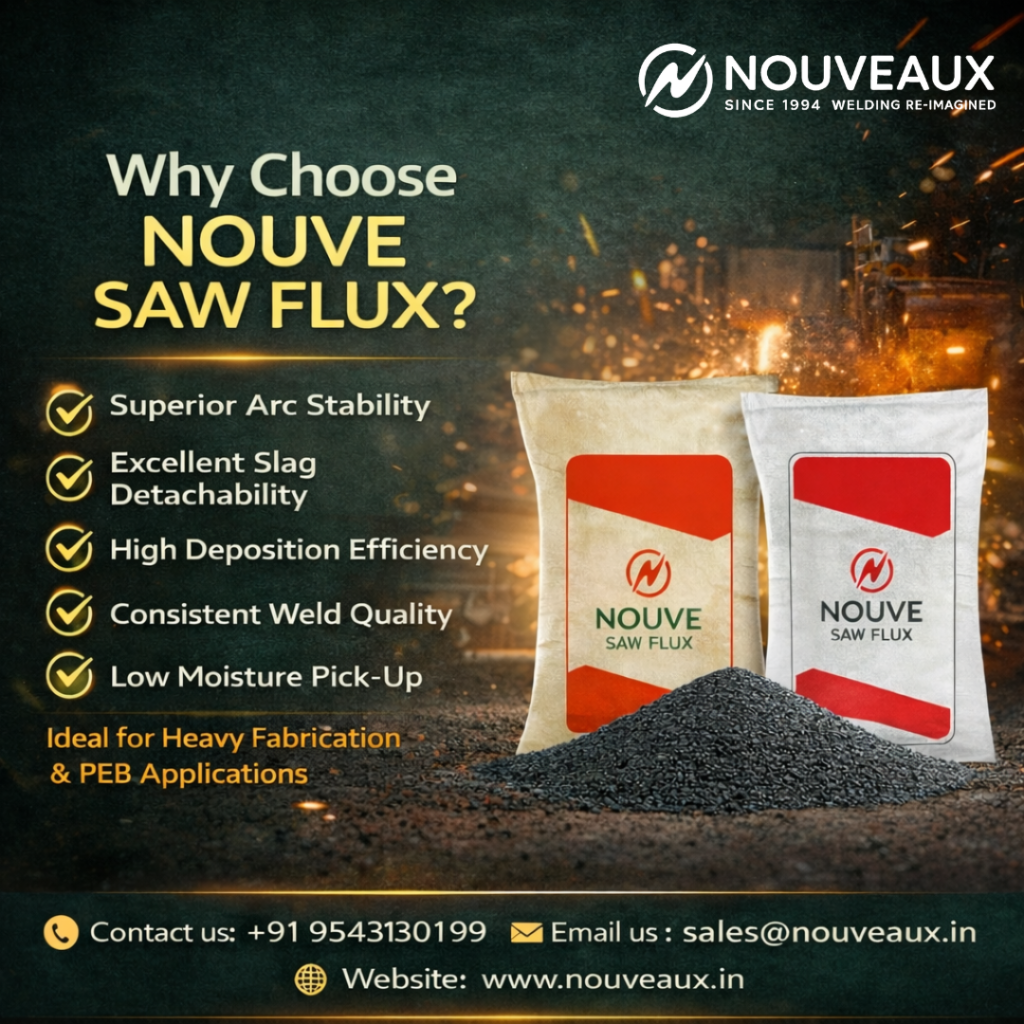
More Than Just a Shield: The Multifaceted Role of Flux
In Submerged Arc Welding, the electric arc is completely submerged beneath a layer of flux. This setup isn’t just for show; the flux performs a complex balancing act during the welding process.
Its primary functions include:
- Atmospheric Protection: The flux melts to form a gaseous shield and a molten slag layer, protecting the hot weld pool from nitrogen and oxygen in the air. This prevents oxidation and porosity.
- Arc Stabilization: Flux contains compounds that ionize easily, helping to maintain a stable and consistent arc, which is vital for automated processes.
- Metallurgical Refining: This is where the magic happens. The flux reacts with the molten metal to remove impurities like sulfur and phosphorus. It can also add alloying elements (like manganese and silicon) to the weld deposit to enhance mechanical properties.
- Bead Shaping: The flux blanket traps the heat, concentrating it into a narrow zone. This allows for deep penetration and influences the width and height of the final bead.
Choosing Your Weapon: Types of SAW Flux
Selecting the right flux is just as important as selecting the right wire. Fluxes are generally categorized by how they are manufactured and their chemical behavior (basicity).
By Manufacturing Method
- Fused Fluxes: Made by melting ingredients in a furnace and crushing them. They are chemically homogeneous and excellent for multi-pass welding, but their use is declining as they cannot accommodate the high deoxidizer demands of modern steels.
- Agglomerated (or Bonded) Fluxes: These are manufactured by mixing dry ingredients with a binder and then baking them. They are chemically heterogeneous, meaning they haven’t fully reacted during manufacturing. This allows manufacturers to add powerful deoxidizers like metallic silicon, resulting in better toughness, especially in low-temperature applications. Today, agglomerated fluxes are the most common in high-quality fabrication.
By Chemical Behavior (Basicity Index)
The Basicity Index is a ratio of basic to acidic compounds in the flux. It determines the mechanical properties of the weld.
- Acidic Fluxes (Basicity < 1.0): These offer superb welding performance, high speeds, and good slag release, especially on slightly rusty steel. However, they leave higher oxygen levels in the weld, which sacrifices impact toughness. They are ideal for single-pass, high-speed production.
- Neutral Fluxes (Basicity 1.0 – 2.5): A balanced option. They don’t significantly alter the weld’s chemical composition, making them ideal for multi-pass welding of thick plates where consistent properties are required.
- Basic Fluxes (Basicity > 1.5): These produce welds with very low oxygen content and exceptional cleanliness. This results in high impact toughness at sub-zero temperatures (e.g., -40°F or lower), making them the go-to choice for offshore rigs, pressure vessels, and critical structures.
| Flux Type | Basicity Index | Key Characteristics | Common Applications |
| Acidic | < 1.0 | High speed, good slag release, low toughness | Single-pass, high-speed welding on thinner materials |
| Neutral | 1.0 – 1.5 | Balanced, consistent chemistry, good performance | Multi-pass welding of unlimited plate thickness |
| Basic | > 1.5 | High cleanliness, excellent low-temperature toughness | Pressure vessels, offshore structures, demanding critical joints |
The Critical Link: Flux and Mechanical Performance
Why do engineers obsess over flux selection? Because it directly dictates whether a weld survives a freezing Arctic night or a high-pressure cycle.
A study on SAW fluxes highlights that the primary purpose of flux is to protect the molten metal and act as an insulator, concentrating heat to improve fusion. However, the review also notes that researchers are in constant pursuit of flux compositions that offer enhanced mechanical properties.
For example, high-basicity agglomerated fluxes are engineered to produce “extremely low levels” of diffusible hydrogen (as low as 2.5 ml/100g in some tests), which is crucial for preventing hydrogen-induced cracking in high-strength steels. The same fluxes can achieve Charpy V-notch impact values averaging over 100 J at -40°C, meeting the stringent requirements of classification societies like ABS, DNV, and LR.
Practical Tips for Industrial Applications
If you are managing a fabrication shop or planning a large-scale project, here is how to approach flux selection:
1. Match the Flux to the Code and Material
Always reference the welding code (e.g., AWS D1.1 for structures, Section IX for pressure vessels). If you are welding high-strength low-alloy steel and need to meet a Charpy requirement of -20°F, you will almost certainly require a basic or neutral flux with a high basicity index, not an acidic flux.
2. Understand “Active” vs. “Neutral”
- Active Fluxes add manganese and silicon to the weld. This is great for single-pass welds to combat porosity, but if used on multi-pass welds, the buildup of these elements can make the weld brittle.
- Neutral Fluxes are safer for multi-pass welding because they don’t significantly change the chemistry, regardless of how many layers you deposit.
3. Don’t Forget the Physical Properties
Flux particle size and handling matter. High-quality agglomerated fluxes are designed with high grain strength. This means they resist crumbling when recycled through the vacuum recovery system, maintaining consistent performance and reducing waste. Always store flux in a dry environment, as moisture can lead to hydrogen cracking.
Conclusion
In the world of industrial welding, the flashy arc often gets the credit, but the flux does the heavy lifting. It is a metallurgical tool that allows fabricators to achieve deep penetration while simultaneously engineering the chemistry and toughness of the weld metal.
Whether you are building a pipeline or a pressure vessel, taking the time to understand the specific type and basicity of your SAW flux isn’t just a technicality—it is the key to ensuring the integrity and longevity of your structure.