
In the world of heavy fabrication, pressure vessel manufacturing, and structural steel, Submerged Arc Welding (SAW) is the workhorse. It delivers the deep penetration, high deposition rates, and superior mechanical properties required for critical applications.
However, even the most advanced SAW equipment is only as good as the consumables it feeds. The combination of the SAW wire and flux is the “recipe” for a sound weld. Choosing the wrong manufacturer—or a low-quality supplier—can lead to porosity, cracking, costly rework, and ultimately, structural failure.
So, how do you separate the industry leaders from the commodity traders? Here is a definitive guide to selecting the best SAW wires manufacturer for your specific industry needs.
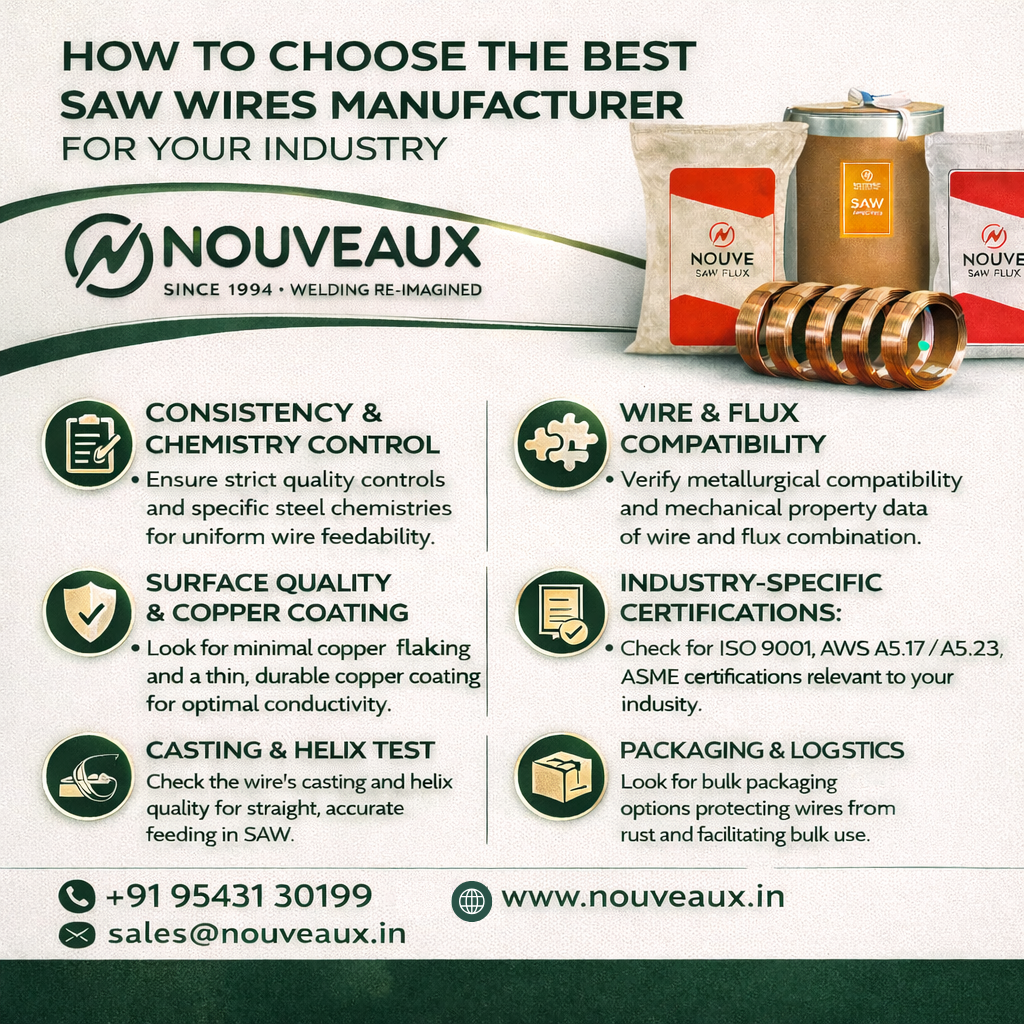
1. Evaluate Consistency and Chemistry Control
In Submerged Arc Welding, consistency is king. Since SAW often involves multi-pass welding over several hours or days, the wire feedability and chemical composition must be uniform from the start of the spool to the end.
What to look for:
- Source Verification: Does the manufacturer control their own raw materials? Top-tier manufacturers use specific steel chemistries designed for welding, rather than repurposed commercial-grade steel.
- Lot-to-Lot Consistency: Request certifications. A reliable manufacturer will have strict quality controls ensuring that the chemistry (Carbon, Manganese, Silicon, etc.) does not fluctuate. A variance of just 0.05% in Carbon can significantly alter the mechanical properties of the weld metal.
2. Matching the Wire to Your Flux (The Partnership Principle)
You don’t just buy SAW wire; you buy a combination. The metallurgical reaction between the wire and the granular flux determines the final outcome.
A knowledgeable manufacturer doesn’t just sell wire; they understand the flux partnership.
- Ask about compatibility: Can they recommend the specific flux type (Fused or Agglomerated) that pairs best with their wire for your base material?
- Mechanical Properties: Ensure the manufacturer provides Procedure Qualification Record (PQR) support or data showing what the wire+flux combination yields in terms of tensile strength, yield strength, and Charpy V-Notch (impact) values.
3. Surface Quality and Copper Coating
SAW wires are often copper-coated to improve conductivity and prevent corrosion. However, poor coating application leads to “flaking.”
The Red Flag: If you see copper dust collecting on your liners and contact tips, you have a quality issue. This flaking causes erratic arc starts and inconsistent electrical conductivity.
- The Best Practice: Look for manufacturers who use a thin, adherent copper coating or modern alternative coatings that bond to the wire surface without peeling. This protects your equipment and ensures a stable arc.
4. Industry-Specific Certifications
A manufacturer that services the general fabrication market may not have the rigor required for your specific sector.
Match the certification to your industry:
- For Offshore & Shipbuilding: Look for approvals from classification societies like DNV, ABS, LR, or BV.
- For Pressure Vessels (Boilers): Ensure compliance with ASME Section II material specifications.
- For Structural Steel: Certifications to ISO 9001 are a baseline, but specific national standards (like AWS A5.17/A5.23) are mandatory.
If your manufacturer can provide these third-party certifications readily, it proves they are audited regularly.
5. The “Casting” and “Helix” Test
This is a practical, often overlooked aspect. “Casting” refers to the diameter of the circle the wire makes when cut from the spool. “Helix” refers to how much the wire rises out of that circle.
Why it matters in SAW: SAW typically uses larger diameter wires (3/32″ to 1/8″). If the casting is too tight or the helix is too high, the wire will oscillate wildly as it exits the contact tip, making it impossible to maintain a consistent stick-out and aim at the joint.
- The Test: A good manufacturer ensures the wire has a controlled cast that allows for straight, accurate feeding through long conduit cables.
6. Packaging and Logistics
SAW is a high-deposition process. Running out of wire mid-weld on a large pressure vessel or pipeline is a disaster.
- Tonnage Options: Can the manufacturer supply in bulk packs? Look for options like “Speed-Feed” drums or wooden reels (for 250kg, 500kg, or even 1000lb+ quantities) that minimize changeover time.
- Protection: SAW wires are susceptible to rust. Ensure the packaging is robust enough to protect the wire from humidity during transit and storage.
7. Technical Support vs. Transactional Selling
Finally, are you buying from a salesperson or a welding engineer?
The best manufacturers employ welding engineers who can visit your site. They can help troubleshoot issues like:
- Slag removal difficulties.
- Hydrogen testing concerns.
- Optimizing travel speeds for your new automated gantry.
A partner who understands the application is worth more than a supplier who just takes an order.
Conclusion
Choosing a SAW wires manufacturer is a strategic decision. It impacts your productivity, your quality control pass rates, and the longevity of your fabricated structures.
Don’t base your decision on price per kilo alone. Base it on total cost per welded joint. By prioritizing consistency, metallurgical expertise, and technical support, you ensure that the “weld behind the weld” is as strong as the joint itself.