
For engineers, project managers, and procurement specialists, specifying welding consumables is a critical task with significant implications for project integrity, safety, and total cost. E2594 (AWS A5.4 Class E2594) electrodes, used for welding super duplex stainless steels like UNS S32750, are not a commodity item. A precise, technically sound specification is essential.
This guide moves beyond basic sales information to provide a framework for the correct technical procurement of E2594 electrodes.
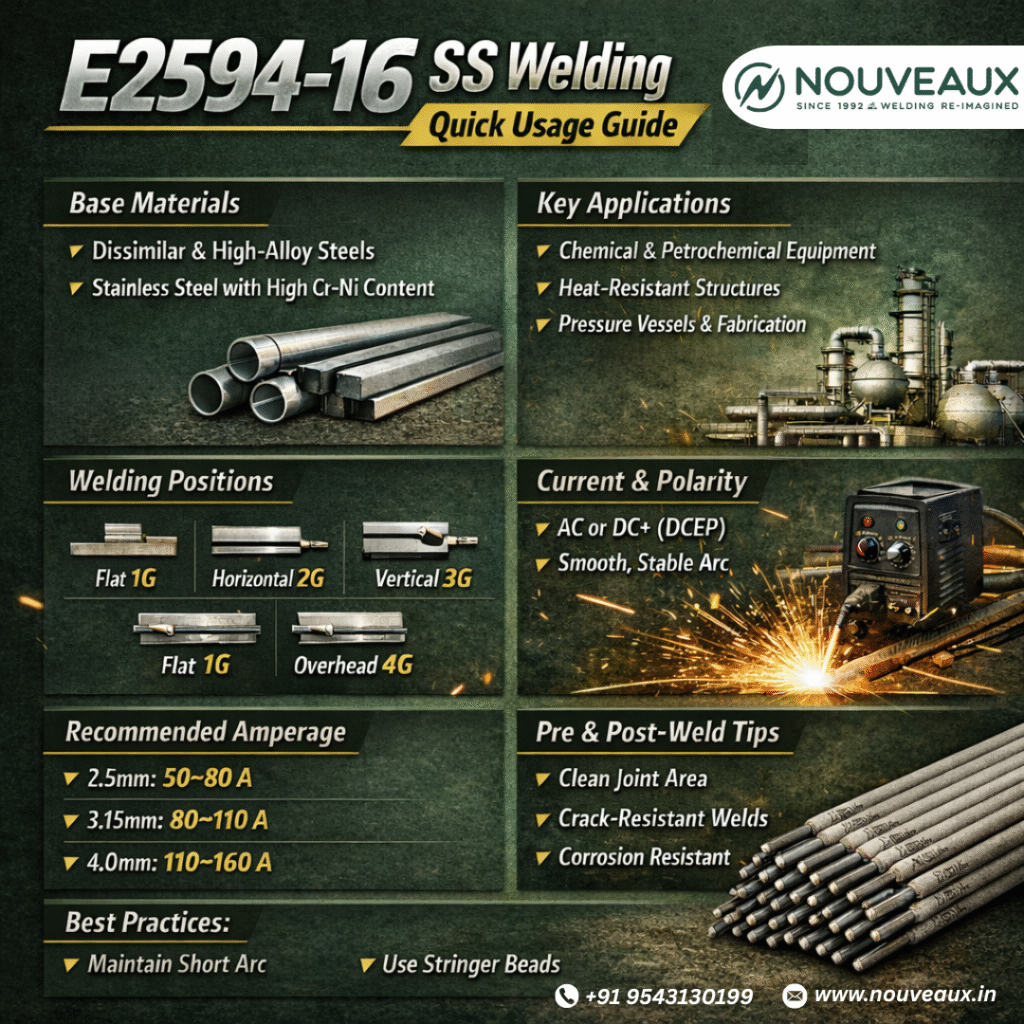
1. Define the Application & Base Material Clearly
The specification process begins long before reviewing supplier catalogs.
- Base Metal Designation: Confirm the exact grade being welded (e.g., UNS S32750 / EN 1.4410 / F53 / SAF 2507). Is it for similar-metal welding or for cladding onto carbon steel?
- Service Environment: Detail the operating conditions: chloride concentration, pH, temperature, pressure, and presence of H₂S (sour service). This justifies the need for E2594 over standard duplex or austenitic grades.
- Governing Standards & Codes: List all applicable construction codes (e.g., ASME BPVC, API, DNV, ABS), customer-specific specifications, and any required welding procedure specifications (WPS/PQR).
2. The Core Specification: Decoding the Requirements
Your procurement document must include the following technical clauses.
A. Mandatory Certification & Compliance
The purchase order must state:
“Electrodes shall conform to AWS A5.4 E2594-XX (specify suffix, e.g., -16 for basic coated, DC+) and be supplied with a Certificate of Compliance (CoC) traceable to the heat/lot number. For marine or offshore projects, additional certification to DNV GL, ABS, or LR standards is required.”
B. Chemical Composition Requirements (Weld Metal Analysis)
Specify the acceptable range for the all-weld-metal chemical composition per AWS A5.4, with particular attention to critical pitting resistance and balance elements:
| Element | AWS A5.4 Minimum | Typical Aim / Maximum | Procurement Note |
| Chromium (Cr) | 24.0% | 24.0 – 26.0% | Primary corrosion fighter. |
| Nickel (Ni) | 8.0% | 8.0 – 10.0% | Stabilizes austenite phase. |
| Molybdenum (Mo) | 3.0% | 3.0 – 4.0% | Key for pitting resistance. |
| Nitrogen (N) | 0.20% | 0.20 – 0.30% | Crucial for strength & phase balance. |
| Carbon (C) | — | Max 0.030% | Low carbon is vital to prevent sensitization. |
| PREN | — | > 40 | *Pitting Resistance Equivalent (Cr + 3.3Mo + 16N) – a key performance indicator.* |
| Ferrite Number (FN) | — | 35 – 65 | (Verified by WPS testing). Ensures proper phase balance for strength and corrosion resistance. |
Specification Clause Example: “The deposited weld metal shall meet the requirements of AWS A5.4 for E2594. The PREN shall be ≥ 40, and the weld metal Ferrite Number, as determined per WPS qualification, shall be within 35-65 FN.”
C. Mechanical Property Requirements
Define the expected properties from the qualified WPS:
- Tensile Strength: ≥ 800 MPa
- Yield Strength (0.2% Offset): ≥ 550 MPa
- Elongation: ≥ 15%
- Impact Toughness (Charpy V-Notch): Specify minimum value (e.g., 45 J) and test temperature (e.g., -40°C / -46°F).
D. Packaging, Identification & Traceability
- Packaging: “Electrodes shall be supplied in hermetically sealed, moisture-proof containers (vacuum packs). Opened containers must be stored in holding ovens at 100-150°C.”
- Identification: “Each electrode shall have a clear, durable coating color code per manufacturer’s scheme. Each package must be marked with AWS classification, batch/lot number, manufacturing date, and shelf life.”
- Traceability: “Supplier must provide full traceability from raw material to finished product for each batch.”
3. Supplier Qualification & Documentation
Procuring E2594 electrodes requires vetting the supplier as much as the product.
- Request for Documentation: Prior to purchase, request for the specific batch:
- Mill Test Certificate / Chemical Analysis Report
- Certificate of Conformity
- Recommended Welding Parameters & Baking Instructions
- Technical Support Capability: Prefer suppliers who can provide welding procedure advice and troubleshoot application issues.
- Brand Reputation: Established, reputable manufacturers (e.g., Sandvik Oerlikon, Böhler, ESAB, Lincoln) typically have more rigorous quality control, ensuring consistency in critical alloy balance.
4. The Procurement Workflow: A Step-by-Step Checklist
- Initiate: Define project requirements (Step 1).
- Specify: Draft technical procurement specification incorporating clauses from Step 2.
- Source: Identify qualified suppliers with proven expertise in high-alloy consumables.
- Request & Review: Obtain and rigorously review supplier documentation against your spec.
- Quality Verification: Upon receipt, verify packaging integrity and markings. Consider third-party testing for critical projects.
- Storage & Handling: Implement strict storage protocols (dry ovens) and issue electrodes to welders via controlled bake-out procedures.
5. Common Pitfalls to Avoid in Procurement
- Prioritizing Price Over PREN: A marginally cheaper electrode with lower alloy content can lead to catastrophic corrosion failure, costing exponentially more in repairs.
- Ignoring Moisture Control: E2594 is a basic/low-hydrogen type. Exposure to humidity invites hydrogen-induced cracking (HIC) in the weld and HAZ.
- Accepting Generic Certificates: Insist on certificates for the specific lot number you are receiving.
- Omitting Ferrite Control: The phase balance is delicate. The electrode must produce weld metal with the correct austenite-ferrite balance to maintain properties.
Procurement Summary: The Non-Negotiables
When specifying E2594 electrodes, your checklist must include:
- AWS A5.4 E2594 Certification with lot-specific Certs.
- Chemical Analysis confirming PREN > 40 and low Carbon.
- Mechanical Property alignment with design requirements.
- Vacuum-Sealed, Traceable Packaging.
- Verified Supplier with technical support capability.
Specify with precision. Weld with confidence. By elevating your procurement spec from a simple purchase order to a technical document, you mitigate risk and ensure the long-term performance of your welded fabrication in the world’s most demanding environments.