
Welding high-strength steel isn’t a task for just any electrode. The integrity of the final structure—whether it’s a massive pressure vessel, a critical structural beam, or heavy mining equipment—depends on using the right filler metal. That’s where the E9018-G electrode comes in.
If you’ve encountered this specific classification and wondered what makes it special, you’ve come to the right place. This guide will break down everything you need to know about the E9018-G, from deciphering its code to mastering the techniques for a flawless, high-strength weld.
Decoding the Name: What Does E9018-G Mean?
The American Welding Society (AWS) classification system tells you everything about the electrode’s capabilities right in its name. Let’s break down E9018-G:
- E: Stands for “Electrode.”
- 90: Indicates the minimum tensile strength of the weld metal. In this case, 90,000 psi (or 620 MPa). This is the key indicator of its high-strength nature.
- 1: Specifies the welding position. A “1” means it’s an all-position electrode (Flat, Horizontal, Vertical, Overhead).
- 8: This digit refers to the flux composition and the resulting current type. An “8” signifies a low-hydrogen, iron powder, potassium flux coating, designed for use with AC or DCEP (Reverse Polarity) current.
- G: The “G” is crucial. It means this is a “General” or “Unspecified” electrode. While it meets the core 90 ksi strength requirement, the exact alloying elements (like Nickel, Chromium, or Molybdenum) are not specified by AWS. The manufacturer formulates it for specific characteristics, so you must consult the manufacturer’s data sheet.
Key Characteristics and Advantages
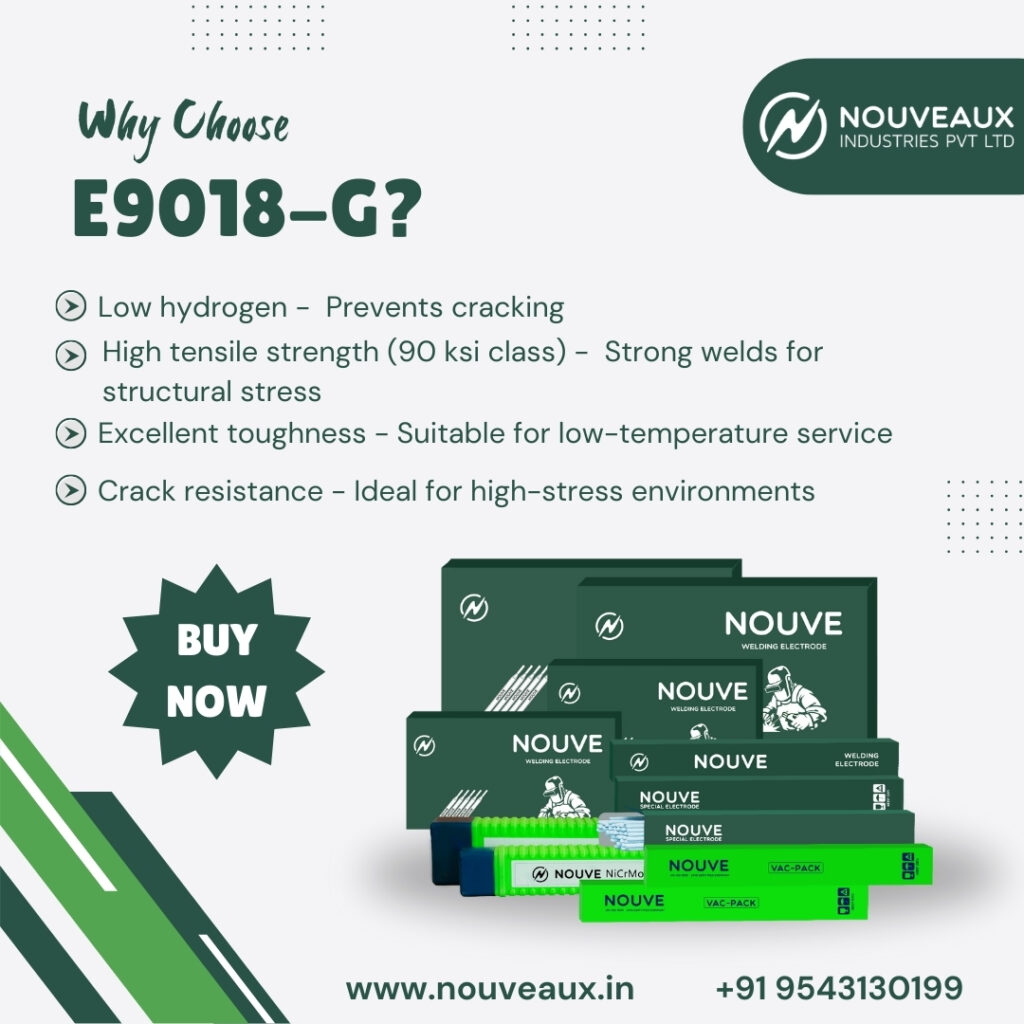
The E9018-G isn’t just defined by its strength; it’s the combination of properties that make it a go-to choice for critical applications.
- High Tensile Strength & Excellent Impact Toughness: The primary reason for its use. It produces welds that can withstand immense stress and have good resistance to brittle fracture, even at lower service temperatures.
- Low Hydrogen Coating: This is a non-negotiable feature for welding high-strength and crack-sensitive steels. The coating is meticulously designed to have minimal moisture content, drastically reducing the risk of hydrogen-induced cracking (HIC), also known as cold cracking.
- Smooth Arc & Exceptional Bead Appearance: Welders love the E9018-G for its stable, smooth arc and easy slag removal. It typically produces a flat to slightly convex bead with a fine rippled appearance that is both strong and cosmetically pleasing.
- High Deposition Efficiency: The flux contains iron powder, which increases the amount of weld metal deposited per rod. This improves travel speed and overall productivity compared to some other low-hydrogen rods.
- Excellent Penetration Profile: It provides a digging arc that offers good penetration without being overly aggressive, making it suitable for a variety of joint configurations.
Common Applications: Where is the E9018-G Used?
You’ll find the E9018-G electrode hard at work in industries where failure is not an option:
- Structural Steel Construction: For welding high-strength ASTM A572 or A992 steel in buildings and bridges.
- Pressure Vessels and Piping: Critical for components that must contain high pressure, often using steels like ASTM A516 Gr. 70.
- Heavy Equipment and Mining: In the manufacturing and repair of excavators, bulldozers, and mining shovels that undergo extreme shock and stress.
- Shipbuilding and Offshore Platforms: Where welds must endure dynamic loads and harsh marine environments.
- General Repair and Fabrication: An excellent choice for any high-strength carbon or low-alloy steel application where the exact grade is unknown, but high strength is required.
E9018-G vs. Other Common Electrodes
How does it stack up against the competition?
- vs. E7018: The E7018 is the versatile workhorse (70,000 psi tensile strength). The E9018-G is its stronger, more specialized cousin. Use E9018-G when the base metal requires higher strength.
- vs. E8018-G: A step down in strength (80,000 psi). The choice between E8018-G and E9018-G depends entirely on the design strength required by the project specifications.
- vs. E6010: The E6010 is a fast-freeze, cellulose rod known for deep penetration on dirty or rusty metal. However, it is a high-hydrogen electrode and is not suitable for high-strength, crack-sensitive steels where an E9018-G would be mandated.
Best Practices for Welding with E9018-G
To unlock the full potential of this electrode, proper technique and procedure are paramount.
- Strict Electrode Storage and Handling: This is the most critical step. As a low-hydrogen electrode, E9018-G is highly susceptible to moisture pickup from the air.
- Storage: Keep them in their original sealed container until use. Store opened packages in a certified holding oven at 250°F – 300°F (120°C – 150°C).
- Rebaking: If electrodes are exposed to air for too long (consult manufacturer’s specs, often >4 hours), they must be rebaked in a separate oven at a higher temperature (e.g., 700°F – 800°F / 370°C – 430°C) to drive off moisture.
- Meticulous Joint Preparation: Cleanliness is key. Remove all moisture, rust, mill scale, paint, and oil from the joint area. Any contaminants can introduce hydrogen and lead to porosity or cracking.
- Correct Welding Parameters: Follow the manufacturer’s recommendations for amperage range. Generally, you’ll use a similar amperage to an E7018 of the same diameter. Maintain a short arc length and use a drag (pull) technique.
- Preheat and Interpass Temperature Control: For thicker materials or highly restrained joints, preheating the base metal is often essential. It slows the cooling rate, allowing hydrogen to diffuse out and reducing the risk of cracking. Always follow the Welding Procedure Specification (WPS) for the required preheat and interpass temperatures.
Frequently Asked Questions (FAQ)
Q: Can I use an E9018-G to weld normal mild steel (like A36)?
A: Technically, yes. However, it is overkill and more expensive than an E7018. The weld will be stronger than the base metal, which isn’t always desirable. It’s best used where its high-strength properties are actually needed.
Q: What is the main difference between E9018-G and E9018-B3L?
A: The “-B3L” is a specific classification for electrodes containing 1.25% Chromium and 0.5% Molybdenum, used for welding specific chrome-moly steels (like P11). The “-G” classification is a catch-all for other unspecified alloys that still meet the 90 ksi strength.
Q: Why are my E9018-G welds porous?
A: The most common causes are damp electrodes, excessively long arc length, or contamination on the base metal (oil, rust). Always ensure your rods are dry and your workpiece is clean.
Conclusion
The E9018-G welding electrode is a premium, low-hydrogen filler metal engineered for demanding applications. Its combination of high tensile strength, superior impact toughness, and excellent weldability makes it indispensable for anyone working with high-strength steels. By understanding its properties, respecting its storage requirements, and following proper welding procedures, you can consistently produce strong, durable, and code-compliant welds that stand the test of time.
Ready to tackle your next high-strength project? Always consult the electrode manufacturer’s data sheet and the relevant Welding Procedure Specification (WPS) to ensure success.