
Master the “Beginner’s Rod” That Pros Trust for Clean, All-Position Results
If you could only have one type of stick welding electrode in your shop, the E6013 would be a top contender. Praised for its ease of use and valued for its consistent performance, this electrode is a bridge between hobbyist projects and professional fabrication. But what exactly makes it so popular, and how do you use it to its full potential? This complete guide breaks it down.
Decoding the E6013: What’s in a Name?
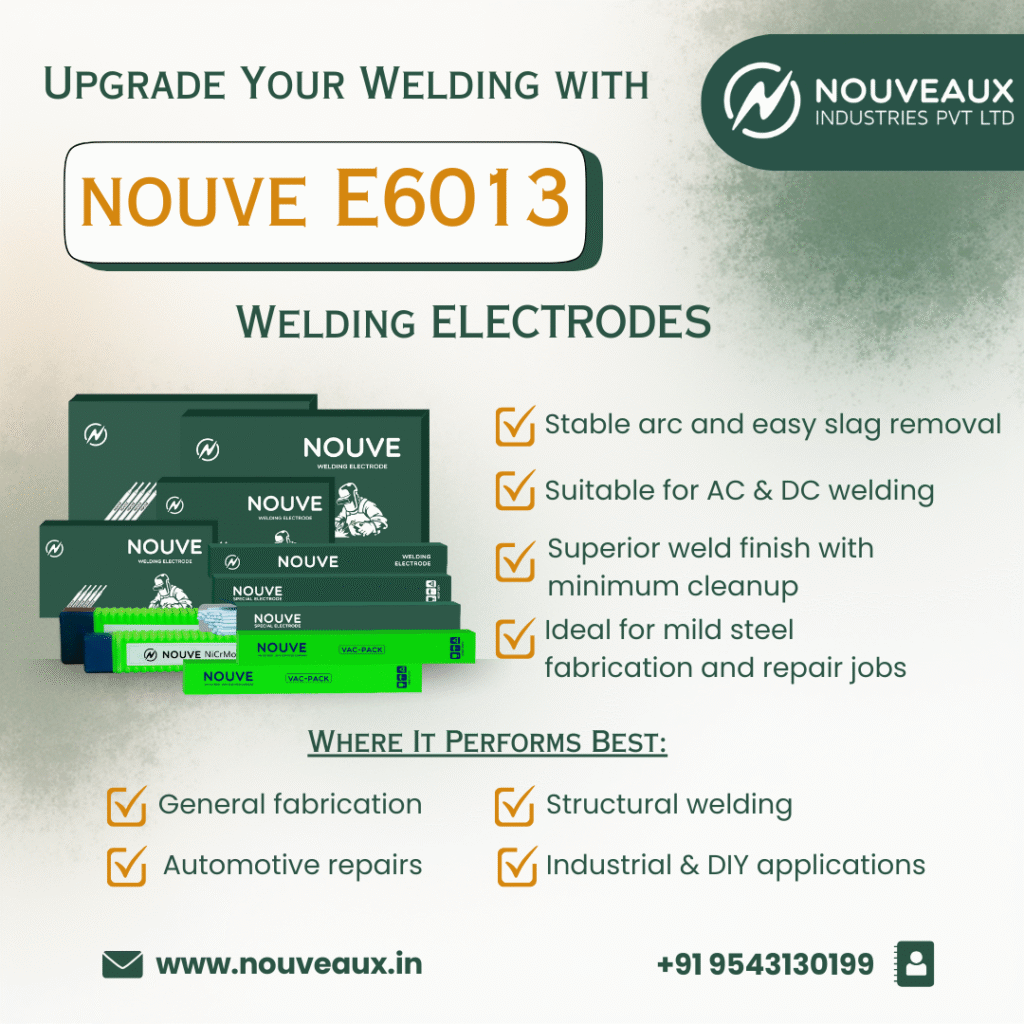
The American Welding Society (AWS) classification is a data sheet in four characters:
- E = Electrode
- 60 = Tensile Strength (60,000 psi minimum)
- 1 = Usable in All Positions (Flat, Horizontal, Vertical, Overhead)
- 3 = Coating Type & Current. A ‘3’ means a rutile (titanium dioxide) potassium-based coating designed to run on AC or DC current.
In plain English: You’re holding a general-purpose, mild steel electrode that’s easy to strike, runs smoothly, and works with almost any common welding machine.
The E6013 “Personality”: Strengths & Best Uses
Why Welders Love It:
- Beginner-Friendly: Its stable, forgiving arc makes learning stick welding less frustrating. It’s less prone to sticking than other rods.
- Smooth Operator: Produces a quiet arc with minimal spatter and a clean, aesthetically pleasing bead with a fine ripple.
- All-Position Champion: Competently handles vertical and overhead work when many other rods are limited to flat surfaces.
- AC Current Compatible: A perfect match for basic AC transformer welders common in home garages and farms.
- Easy Slag Removal: The slag (the glassy coating that forms) typically lifts off in one neat piece.
- Good for Thin Metal: Its light to medium penetration helps prevent burn-through on sheet metal (down to ~16 gauge).
Ideal Project Applications:
- Automotive exhaust repairs (non-structural)
- Sheet metal fabrication (ductwork, enclosures)
- General maintenance, repair, and fabrication (gates, furniture, brackets)
- Welding over mild surface contamination (light rust, mill scale)*
- Projects where weld appearance is important
**Best practice is always to clean your metal first for the strongest weld.
Knowing Its Limits: When to Choose Another Rod
The E6013 is a jack-of-all-trades, but it’s not the master of structural, high-stress work. Consider a different electrode for:
- Critical Structural Welds: For trailers, load-bearing frames, or structural steel, the low-hydrogen E7018 is typically required for its superior strength and ductility.
- Deep Penetration Needs: On thick metal requiring single-pass, full-penetration joints, the digging arc of an E6010/E6011 is more effective.
- Heavily Contaminated Metal: While tolerant, for very rusty, painted, or dirty metal, E6011 performs better.
- Overhead Welds (Pro Preference): Many professionals prefer the faster-freezing puddle of an E6010 for overhead work as it’s less likely to sag.
Mastering the Machine: Setup & Technique
Selecting Polarity (For DC Machines):
- DCEN (Direct Current Electrode Negative/-): Softer arc, less penetration. Excellent for sheet metal, vertical down welds.
- DCEP (Direct Current Electrode Positive/+): More forceful arc, deeper penetration, better stability. A great default setting.
Quick Tip: If you’re on an AC machine, polarity isn’t a choice—just set your amps.
Amperage Settings (General Starting Points)
- 1/8″ (3.2mm) Electrode: 110-150 Amps
- 3/32″ (2.4mm) Electrode: 70-110 Amps (The most common, versatile size)
- 5/32″ (4.0mm) Electrode: 150-220 Amps
Always refer to the manufacturer’s range on the box. Start in the middle, then adjust. Too hot? The rod will glow, and the puddle will be fluid and hard to control. Too cold? The arc will be unstable, and the bead will sit high with poor fusion.
Essential Technique Tips
- Short Arc Length: Maintain a tight arc where the flux coating nearly touches the workpiece. A long arc causes spatter and porosity.
- Use a Drag Technique: Hold a 5- to 15-degree angle, dragging the electrode toward you (pulling the puddle). This provides good visibility and penetration control.
- Watch the Puddle, Not the Arc: Focus on the leading edge of the molten weld puddle. Its width and fluidity tell you if your speed and heat are correct.
- For Vertical Welds:
- Vertical Up: Use a slight “Z” or triangle weave, pausing at the edges to prevent undercut and ensure sidewall fusion.
- Vertical Down: Ideal for thin metal. Use a straight drag with a very short arc for fast travel speed and less heat input.
Pro Insights & Common Questions
Storage & Handling:
While not as moisture-sensitive as E7018 rods, store E6013 electrodes in a dry, sealed container. For optimal results in humid environments, a holding oven at 100-150°F (40-65°C) is a good practice.
E6013 vs. The World: A Quick Comparison
- vs. E6011: E6011 has a cellulose coating, a more aggressive “digging” arc, and handles dirtier metal. E6013 is smoother and leaves a cleaner bead.
- vs. E7018: E7018 is a low-hydrogen, high-strength rod requiring DC and strict storage. It’s for structural integrity; E6013 is for general-purpose versatility and ease.
FAQ:
- Can I weld vertical up with E6013? Yes, successfully. It requires a tighter weave and good arc control compared to some rods, but it’s very capable.
- Is it really just for beginners? No. Its ease makes it great for learning, but its all-position capability and clean bead make it a valuable “quick job” rod for professionals, especially on non-critical applications.
Conclusion: The Essential All-Rounder
The E6013 welding electrode earns its reputation as a workshop staple. It lowers the barrier to entry for beginners while providing enough finesse and control for professionals to rely on for a wide array of tasks. By understanding its ideal applications, respecting its limitations, and applying the proper technique, you can consistently produce strong, clean welds that get the job done.